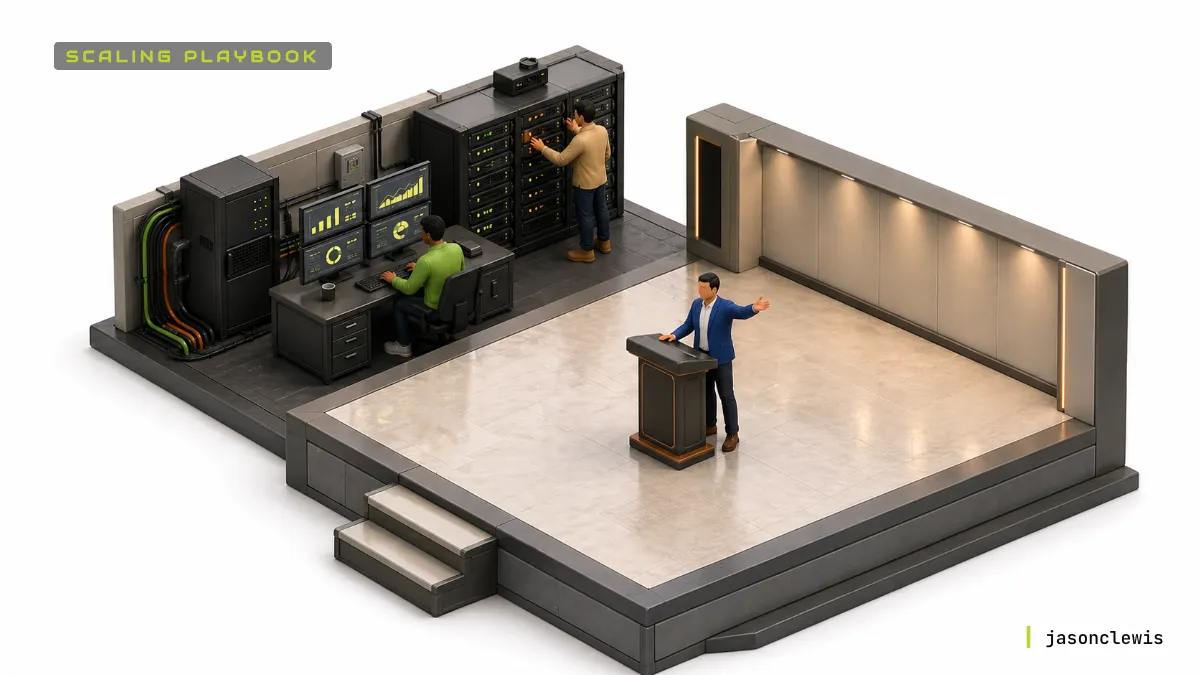
TL;DR: From the vantage of someone watching hundreds of AI workloads run under real traffic, the pattern is consistent: what gets posted rarely survives a second customer. Conference demos optimize for a single happy path; production exposes concurrency, cost, drift, and operator load. This piece gives you a six-test discipline to filter any AI claim before it earns a line in your roadmap.
What operators see after the demo ends
You are saturated with AI signal. Every feed, every panel, every investor call is someone confidently describing what’s working — and you are quietly unsure whether that confidence is earned. The conversation has more participants than operators, and it shows.
I spend my days on the other side of that conversation. Inside the support teams that manage the workloads after the demo ends — when concurrency climbs, when the bill arrives, when the customers arrive and the system that worked beautifully for the first customer struggles to perform at scale. The view is unglamorous and clarifying. It is also where the gap between frontier theater and production reality becomes impossible to ignore.
What gets celebrated on stage is a capability under perfect conditions. What runs in production is that same capability under adversarial conditions you didn’t get to choose. The discipline below is how I separate the two.
Why conference narratives diverge from production reality
The divergence is structural, not malicious. Three forces drive it.
Demos optimize for a single happy path. A stage demo is a controlled environment with one user, curated inputs, and a known model state. Production is the opposite of every one of those conditions — many users, hostile inputs, models that drift, infrastructure that degrades. The same prompt that lands a standing ovation can fail under ten concurrent calls. This is not a flaw in the demo; it is a feature of the format. The format simply does not test what production tests.
Posting rewards novelty; running rewards reliability. The incentive structure of social platforms favors the new model, the new pattern, the new framework. The incentive structure of a customer-facing system favors the boring thing that worked yesterday and will work tomorrow. These are not the same incentive. Founders who confuse them ship a roadmap built from a feed.
Selection bias filters out the failures. You hear about the workload that scaled. You don’t hear about the seventeen that quietly rolled back. Production is full of rollbacks, and rollbacks don’t make conference talks. The published gap between benchmark performance and deployed behavior — documented in Stanford’s HELM — is the visible tip; the rollback distribution sits below the waterline because no one announces a regression.
The six-test signal-versus-noise framework
Apply these to any AI claim, model release, or architectural pattern that crosses your desk this quarter. Each test has a one-line definition you can quote, a rationale grounded in what fails at scale, and a production pattern to look for.
Test 1: Does it survive concurrency?
Definition: A capability that works for one user but degrades for ten is a demo, not a system.
Most published AI demos are single-tenant, single-request showcases. Production traffic is concurrent, bursty, and uneven. Latency variance under load is the most reliable indicator of whether a workload has been operated or merely built. Ask: what does P95 latency look like at peak? What happens to accuracy under queueing? If the answer is “we haven’t measured,” the capability has not been to production.
Test 2: Does it survive cost?
Definition: A capability that works only with unlimited inference budget is a science project, not a product.
The economics of AI workloads compound differently than traditional software. A pattern that costs $0.24 per call is fine in a demo and lethal at a million calls a day. The teams that scale are the ones who treat unit economics as a first-class engineering constraint from the first week — not the ones who plan to optimize later. Ask: what is the per-customer marginal cost at the volume your contract requires? If the team can’t answer in cents, they are not yet operating.
Test 3: Does it survive a second customer?
Definition: A pattern that works for one customer but breaks on the second is a prompt, not a product.
This is the test I see fail most often, and it is the one demos cannot expose. The first customer’s data, language, and edge cases get baked into the prompt, the retrieval logic, the evaluation set. The second customer arrives with different vocabulary and the system collapses in subtle ways — wrong entities extracted, wrong tone generated, wrong confidence calibration. Ask: how many distinct customer contexts has this been tested against, and what did the team have to change between them?
Test 4: Does it survive drift?
Definition: A capability that works on the day it ships but degrades over weeks is a snapshot, not a service.
Models drift when providers retrain. Inputs drift when customers change how they phrase requests. The world the model was evaluated against drifts when the underlying domain moves — pricing, regulation, taxonomy. Without continuous evaluation infrastructure, every AI system is silently getting worse, and the team running it usually finds out from a customer. The teams who survive at scale built the eval harness before they built the feature. Ask: what is the team’s eval cadence, and what triggers a rollback? If there is no answer, drift is already underway and no one is watching.
Test 5: Does it survive an outage?
Definition: A capability with no graceful degradation is a single point of failure dressed up as a feature.
Inference endpoints fail. Providers throttle. Networks partition. The question is what the user experiences when the model is unavailable — a clear fallback, a degraded but functional path, or a broken product. Ask: what is the failure mode when the primary model returns nothing? Production-grade systems answer this in their architecture diagram. Demos answer it with a shrug.
Test 6: Does it survive the operator?
Definition: A capability your on-call team cannot debug at 2 a.m. is technical debt, not infrastructure.
The hidden cost of AI systems is operational load — observability, prompt versioning, eval pipelines, incident response when the model says something it shouldn’t. A pattern that requires a researcher to debug is not yet a system. Ask: can a normal SRE diagnose a regression without a notebook? If the answer is no, you are buying a research artifact and calling it a platform.
Six tests are useful in the abstract. They earn their keep when you map them to the patterns currently dominating the feed.
Two contrasts the framework makes legible
Pattern | What gets posted | What runs in production | Tests that bite |
|---|---|---|---|
Retrieval-augmented generation | The model cites the right document and answers the right question. | A pipeline that's right 70% of the time, subtly wrong 20%, and confidently fabricating the rest — with eval harness, citation verification, and human review stitched around it to make the 70% usable. | 3, 4, 6 |
Autonomous agents | An agent books the meeting, sends the email, and closes the loop. | A heavily scoped tool-use chain with hard timeouts, retry budgets, idempotency keys on every side effect, and a kill switch a human can hit when it loops. | 1, 2, 5 |
The thing on stage is a sketch of the thing in production — and the gap between them is months of unglamorous engineering.
Common failure modes — where this discipline breaks
The framework breaks in three predictable ways, and each one has a tell.
You apply it to the demo instead of the system behind the demo. The tests are designed to interrogate production behavior, not stage behavior.
The tell: If you find yourself grading a keynote, you have already lost. Apply the tests to the workload, not the announcement.
You let one test override the others. Cost-test enthusiasts kill capabilities that would have generated revenue. Concurrency hawks kill experiments that needed a quarter to mature. The tests are a panel, not a tournament — a capability can be early on test 4 and still worth piloting if it is strong on tests 1, 2, and 3. Use the framework to map risk, not to manufacture vetoes.
The tell: you find yourself dismissing a capability on a single test before you’ve scored the others.
You apply it to your competitors and not to yourself. The most expensive version of this mistake is using these tests to dismiss external claims while letting your own roadmap skip them. Run the tests on your own quarterly bets first. The discomfort is the signal.
The tell: you can recite the gaps in a competitor’s roadmap but not in your own.
If those are the ways the discipline goes wrong, the version below is what it looks like when it goes right — compressed to one screen.
The one-screen checklist
Paste this into your next architecture review, vendor evaluation, or roadmap doc. It is the framework compressed to the size of a Slack message.
SIX-TEST AI SIGNAL FILTER
Run every AI claim — internal or external — through these before committing engineering.

[ ] 1. CONCURRENCY  — What is P95 latency at peak? Does accuracy hold under queueing?
[ ] 2. COST         — What is the per-call marginal cost at contract volume? (Answer in cents.)
[ ] 3. SECOND CUSTOMER — How many distinct customer contexts tested? What changed between them?
[ ] 4. DRIFT        — What is the eval cadence? What triggers a rollback?
[ ] 5. OUTAGE       — What is the failure mode when the primary model returns nothing?
[ ] 6. OPERATOR     — Can a normal SRE diagnose a regression without a notebook?

DECISION RULE
- 6 of 6 answered in operational terms → commit.
- 4–5 of 6 → pilot with a defined exit criterion.
- ≤ 3 of 6 → the capability is earlier than it appears. Hold.

WATCH-OUT
Run this on your own roadmap before you run it on anyone else's.
The discomfort of grading your own work is the signal you are using it correctly.
The reframe
Stop consuming AI commentary. Start filtering it. The conversation will not slow down, the volume will not drop, and the confident voices will not get quieter. Your job is not to weigh another opinion against the others — your job is to apply a discipline that is indifferent to who is talking.
The six tests above are that discipline. Carry them into your next architecture review, your next vendor pitch, your next board meeting where someone confidently describes what’s working in AI. Ask which tests the claim has survived. The answers, or the silences, will tell you what you needed to know.
The frontier is not where the posts are. The frontier is where the workload is still running on Monday morning.
Part of The Four Scaling Decisions That Compound — and How to Tell You’re About to Get One Wrong — the operator’s-seat overview of the four scaling decisions that compound between Series A and Series C.
FAQ
Q: What separates production AI from demo AI? A: Production AI has been tested against concurrency, cost, second-customer generalization, drift, outages, and operator load. Demo AI has been tested against a single happy path. The gap between the two is where most AI roadmaps quietly fail — not because the underlying capability is fake, but because the engineering required to operate it at scale was scoped out of the original promise.
Q: How should a founder evaluate AI claims before committing engineering resources? A: Apply the six-test framework — concurrency, cost, second customer, drift, outage, operator — to the specific workload, not the announcement behind it. If the team making the claim cannot answer at least four of the six in operational terms, the capability is earlier than it appears. Treat that as a signal to pilot, not commit.
Q: Why does what works on stage often fail at scale? A: Stage demos are single-user, single-request, controlled-input environments. Production is concurrent, adversarial, and economically constrained. The same prompt or model that performs flawlessly in front of an audience can fail under ten concurrent calls, a cost ceiling, or a second customer with different vocabulary. Stage performance is not predictive of production performance — and the format of a demo is structurally incapable of testing what production tests.
Q: What do operators see in AI workloads that conferences don’t show? A: Rollbacks, latency variance under load, cost overruns at scale, second-customer generalization failures, drift on systems that worked at launch, and the operational burden that researchers carry when their pattern reaches production. None of these make for good keynotes. All of them determine whether a capability becomes a product or stalls as a science project.
Q: How do I filter AI signal from noise as a founder? A: Decide once that you will not weigh opinions — you will apply a discipline. The six tests above give you a repeatable filter that is indifferent to who is making the claim. Run every AI bet on your own roadmap through the same tests before you run them on anyone else’s. The discomfort of grading your own work is the signal you are using the framework correctly.
Q: Can this framework be applied to internal AI projects, not just external claims? A: It should be applied there first. The most expensive version of this mistake is using these tests to dismiss what others are building while letting your own quarterly bets skip them. Run the tests on your own workloads, surface the gaps, and treat them as the operational roadmap for the next quarter. That is how the framework converts from a critique into a discipline.